


Hybrid enterprise environments created a completely different set of access security challenges for organizations over the last several years.
Security teams are no longer managing privileged access inside a single centralized environment. Modern infrastructure now stretches across cloud systems, remote work environments, on-premises networks, SaaS applications, third-party vendor access workflows, and distributed administrative teams. Visibility becomes much harder to maintain once privileged accounts start moving across multiple environments simultaneously.
That shift changed what organizations expect from privileged access management platforms.
A few years ago, many PAM tools focused primarily on credential vaulting and privileged password rotation. Those capabilities still matter, but hybrid infrastructure requires much deeper visibility and control. Security teams now want session monitoring, identity threat detection, privileged elevation management, secure remote access workflows, and faster incident response capabilities inside the same platform.
Deployment flexibility also became much more important. Large organizations rarely operate entirely in the cloud or entirely on premises anymore. Most enterprises now manage a combination of both, which means PAM platforms need to support hybrid environments without creating operational complexity or forcing major infrastructure redesigns.
As a result, enterprise buyers increasingly evaluate PAM vendors based on scalability, deployment flexibility, session intelligence, and identity security capabilities rather than password management alone.
Here are seven PAM platforms organizations frequently evaluate for hybrid enterprise infrastructure in 2026.
1. Syteca
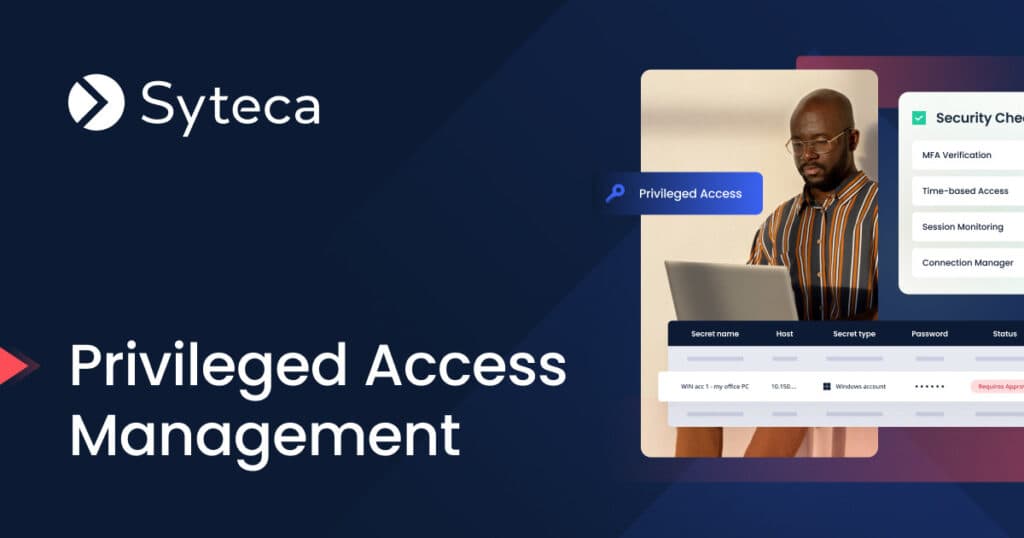
Syteca’s privileged access management platform stands out because the platform combines privileged access management and identity threat detection capabilities inside the same architecture rather than treating ITDR as a separate add-on layer.
That distinction matters in hybrid enterprise environments where privileged sessions move constantly between cloud infrastructure, remote endpoints, third-party access workflows, and internal systems.
Instead of focusing only on credential vaulting, Syteca places strong emphasis on session intelligence and behavioral visibility. The platform monitors privileged activity continuously and allows security teams to identify suspicious behavior patterns earlier during active sessions.
Core capabilities include:
- Credential vaulting
- Privileged elevation management
- Just-in-time access provisioning
- Session recording
- Multi-factor authentication
- Secure vendor access workflows
- Real-time alerts
- Automated response actions
- Session blocking
- Continuous session validation
The platform also supports cloud, hybrid, and fully on-premises deployments without requiring extensive professional services during onboarding.
That operational flexibility appeals strongly to organizations trying to modernize access security without redesigning existing infrastructure completely.
Another major differentiator is deployment speed. Many enterprise PAM platforms require long implementation cycles and significant consulting involvement before organizations become fully operational. Syteca positions itself as a faster deployment alternative with more manageable onboarding requirements.
The platform supports organizations ranging from smaller security teams to large enterprise environments and is frequently evaluated by companies looking for stronger privileged session visibility combined with identity threat detection functionality.
2. CyberArk
CyberArk remains one of the most recognized names in the PAM market, especially among large enterprise organizations managing highly complex infrastructure.
The platform focuses heavily on enterprise-grade privileged access control, credential protection, and identity security workflows.
CyberArk’s capabilities include:
- Privileged credential vaulting
- Least privilege enforcement
- Privileged session management
- Endpoint privilege management
- Secure remote access
- Identity security integrations
Compared to lighter PAM platforms, CyberArk operates as a much broader enterprise security ecosystem.
That depth works well for organizations with mature security operations and dedicated PAM administration resources. Large enterprises running complex global infrastructure often evaluate CyberArk because of its scalability and extensive integration capabilities.
At the same time, some organizations view implementation complexity and operational overhead as trade-offs compared to more streamlined PAM solutions.
3. BeyondTrust
BeyondTrust built a strong position in the PAM market by combining privileged access management with broader vulnerability and endpoint security capabilities.
The platform supports hybrid infrastructure environments through features such as:
- Privileged remote access
- Endpoint privilege management
- Session monitoring
- Credential management
- Secure vendor access
- Least privilege enforcement
BeyondTrust is frequently evaluated by organizations trying to consolidate multiple security workflows into fewer platforms.
Its remote access capabilities are especially relevant for enterprises managing distributed teams and third-party contractors across hybrid environments.
Compared to some traditional PAM vendors, BeyondTrust places stronger emphasis on balancing privileged access security with operational usability for internal IT teams.
4. Delinea
Delinea focuses heavily on simplifying PAM deployment and management for organizations that want strong privileged access security without excessive operational complexity.
The platform supports hybrid infrastructure through cloud-based and on-premises deployment options while offering:
- Credential vaulting
- Privileged session management
- Application access controls
- Least privilege management
- Behavioral analytics
- Access governance workflows
Delinea is often evaluated by organizations seeking more flexible PAM deployment models compared to heavily infrastructure-dependent enterprise platforms.
The company also places strong emphasis on usability and simplified administration, which appeals to security teams trying to reduce operational overhead while maintaining strong privileged access controls.
5. WALLIX

WALLIX positions itself strongly around privileged access governance and secure remote access management for critical infrastructure and enterprise environments.
The platform includes capabilities such as:
- Privileged account management
- Session recording
- Secure remote access
- Credential management
- Access governance
- Compliance support
WALLIX is frequently evaluated by organizations operating inside regulated industries where visibility into privileged activity and audit readiness play a major role in security operations.
Its hybrid infrastructure support also makes the platform relevant for organizations managing mixed cloud and on-premises systems simultaneously.
Compared to some broader enterprise ecosystems, WALLIX often emphasizes operational visibility and governance simplicity more heavily.
6. ManageEngine PAM360

ManageEngine PAM360 is commonly evaluated by organizations looking for centralized privileged access management with relatively straightforward deployment and administration.
The platform includes:
- Credential vaulting
- Remote access management
- Privileged session monitoring
- File transfer auditing
- Password rotation
- Audit reporting
Compared to some enterprise-focused PAM ecosystems, PAM360 is often viewed as more operationally accessible for mid-sized organizations and growing enterprise environments.
Its centralized management approach works especially well for IT teams trying to improve privileged access visibility across distributed infrastructure without implementing a highly complex PAM architecture.
7. One Identity

One Identity approaches privileged access management as part of a broader identity governance and security strategy.
The platform supports hybrid enterprise infrastructure through capabilities such as:
- Privileged password management
- Session monitoring
- Privileged analytics
- Identity governance integrations
- Secure access workflows
- Policy enforcement
One Identity is frequently evaluated by enterprises trying to align privileged access security more closely with broader identity governance programs.
The platform’s integration capabilities appeal strongly to organizations already operating large identity and access management ecosystems across hybrid infrastructure environments.
Compared to narrower PAM tools, One Identity often positions itself around enterprise-wide identity security visibility and governance alignment.
Hybrid infrastructure changed PAM requirements permanently
The PAM market looks very different today compared to several years ago.
Organizations no longer evaluate privileged access management platforms only around password vaulting or isolated administrator controls. Hybrid infrastructure forced security teams to think much more broadly about privileged access visibility, session intelligence, remote access security, and identity threat detection.
That shift explains why modern PAM platforms increasingly combine multiple security capabilities inside unified architectures.
Security teams now expect privileged access platforms to support:
- Cloud environments
- Remote workforces
- Third-party vendors
- Hybrid deployments
- Compliance initiatives
- Faster incident response
Operational flexibility also became a major evaluation factor because enterprises rarely want long deployment cycles or infrastructure-heavy onboarding processes anymore.
Enterprise buyers increasingly prioritize visibility and flexibility
Large organizations evaluate PAM vendors differently depending on infrastructure complexity, compliance requirements, and internal security maturity.
Some enterprises prioritize deep customization and large-scale identity ecosystems. Others focus more heavily on deployment flexibility, operational simplicity, and faster onboarding.
That difference explains why the PAM market continues to support both highly complex enterprise platforms and more streamlined hybrid infrastructure solutions.
Syteca stands out because the platform combines PAM and identity threat detection capabilities inside a single architecture while maintaining flexible deployment support across cloud, hybrid, and on-premises environments.
For many organizations managing modern enterprise infrastructure, privileged access management is no longer only about securing credentials. Increasingly, it is about improving visibility into privileged activity before identity-based threats become larger operational security incidents.



Leave a Reply
You must be logged in to post a comment.