


A product manager at a UK payroll software company once spent three months building bank data connections in-house. Three engineers. Two compliance reviews. One failed audit because the consent flows weren’t right. They scrapped the whole thing and looked for an API instead.
That story happens more often than people admit.
Open banking data aggregation sounds simple. Connect to banks. Pull transaction data. Get account balances. But the reality gets messy fast. Each bank has different authentication requirements. Data comes back in different formats. Consent expires at different times. Regulatory expectations keep shifting.
UK platforms have learned something valuable over the past few years. Building your own bank connections is rarely worth the headache. The five companies below handle that complexity, so you do not have to.
1. Finexer
Finexer operates from London at 124 City Road. The company holds FCA authorisation for both AIS and PIS. That means platforms get bank data access and payment initiation from a single integration.
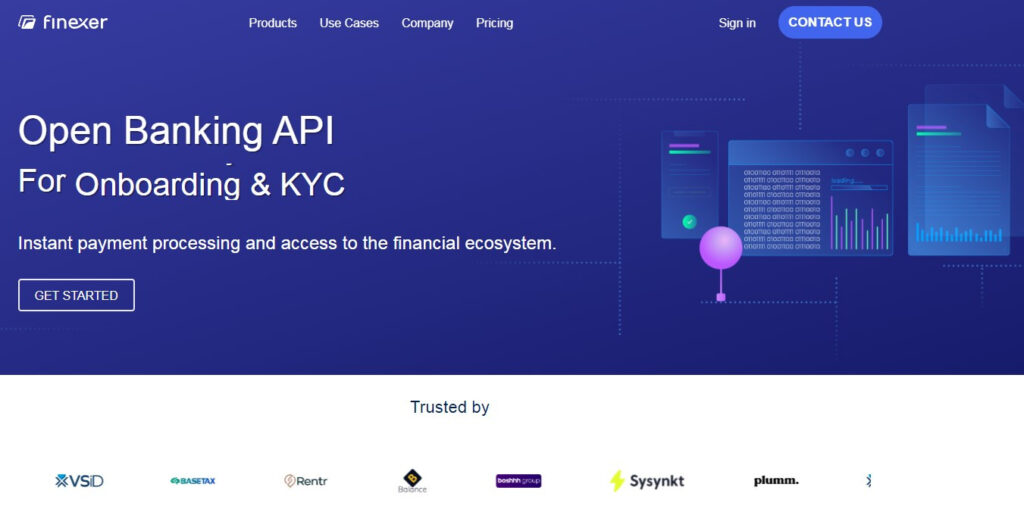
Here is what makes Finexer different for UK platforms. The unified API combines account information services with payment initiation services. One integration covers data retrieval, Pay by Bank payments, and verification workflows.
The numbers matter for UK-focused platforms. Finexer covers 99% of UK banks, including major institutions and challenger banks like Monzo, Starling, and Revolut. Transaction history goes back up to seven years. Data arrives structured with merchant identifiers and category codes.
Customer reviews across multiple platforms tell a consistent story. On Product Hunt, Finexer holds a 4.67 out of 5 rating from six reviews. One reviewer mentioned deployment was two to three times quicker than other providers. The same person praised the intuitive dashboard that simplified integration for their engineering team.
OMR Reviews shows positive feedback from verified users in the accounting, legal, and real estate sectors. A law firm partner wrote that source of funds checks now run in minutes. The platform provides regulator-ready data that gives confidence that compliance standards are met.
The pricing structure is transparent. Startup plans come with discounted pricing for new businesses. Standard plans suit established, growing companies. Enterprise offers volume-based pricing. No setup fees. No cancellation fees. The sandbox environment costs nothing to test integrations before going live.
2. Plaid
Plaid started in San Francisco in 2013. The company built its reputation connecting apps to bank accounts for Venmo, Coinbase, and Robinhood. Today, Plaid covers more than 12,000 financial institutions across North America, the UK, and parts of Europe.
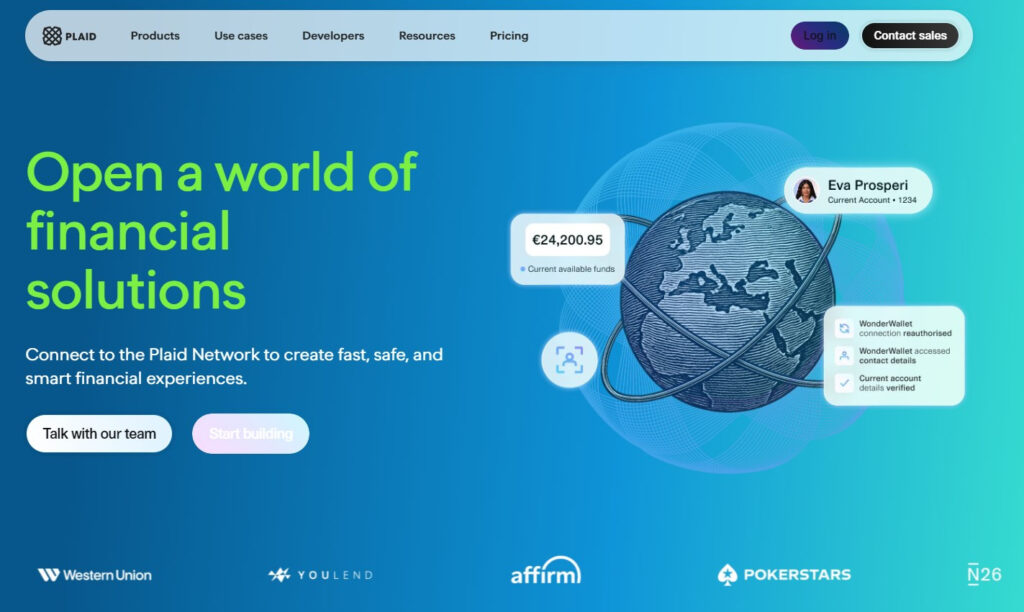
For UK platforms, Plaid brings serious scale. The company supports Auth for account verification, Transactions for data access, Identity for KYC, and Balance for real-time fund checks. Plaid Transfer handles ACH origination and open banking payments in the UK.
The developer experience stands out. Plaid Link provides a standardised connection flow that customers recognise from hundreds of apps. The documentation ranks among the cleanest in the industry. Engineers can go from sign-up to a live link token faster than with most competitors.
Pricing remains opaque. No public rate cards exist. Everything gets negotiated case by case. Reddit forums suggest API calls run between 25 cents and one dollar each, depending on usage. Enterprise clients get custom quotes.
Customer reviews tell two different stories. On Trustpilot, Plaid scores 1.3 out of 5 with mostly negative feedback. On G2, the rating sits around 4 out of 5. Common complaints include connectivity hiccups, slow support responses taking 24 to 72 hours, and failed transactions. Positive reviews highlight the wide bank coverage and reliable infrastructure for fintech use cases.
Plaid works best for platforms that need multi-region coverage. The UK presence exists but remains thinner than North American coverage. European expansion continues through direct integrations.
3. TrueLayer
TrueLayer launched in London in 2016. The company now has offices in Dublin, Sydney, Milan, and Hong Kong. Major investors include Stripe, Tiger Global, and Tencent. The Series E funding round in September 2021 raised £95 million at a £1 billion valuation.
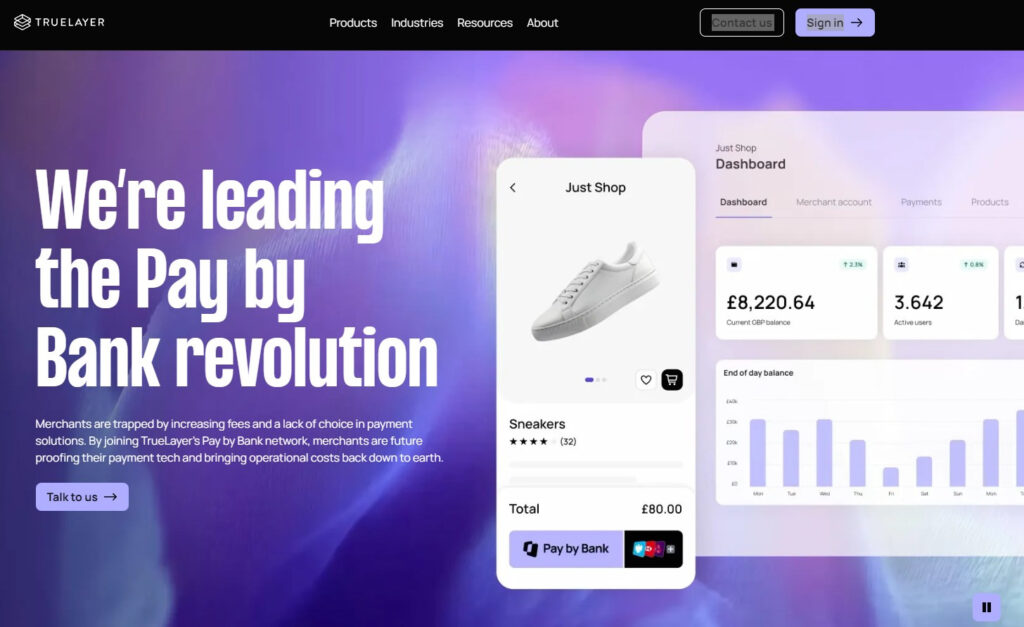
Payments drive TrueLayer’s business. The platform processes billions in account-to-account payment volume across the UK and EU. Instant bank payouts, variable recurring payments, and refunds are core products. Account and transaction data exist, but payments take the spotlight.
The results from real customers tell the story. JamDoughnut, a cashback app, runs 90% of its checkout payments through TrueLayer. The conversion rate sits above 90% on the first attempt. About 85% of transactions come from returning customers who keep choosing Pay by Bank.
Nutmeg, the UK’s largest digital wealth manager with over 100,000 customers, integrated TrueLayer for investor onboarding. Payments via open banking now account for around a quarter of all Nutmeg payments. Customers chose the option themselves without any push from the platform.
TrueLayer offers verification capabilities through a name-matching engine. The system cross-checks user names against bank records, and returns match, no match, or no account holder name found responses. Face ID and fingerprint authentication work through the user’s banking app.
TrueLayer does not disclose pricing on its website. You fill out a form and wait for a sales contact. Some sources report no API sandbox for testing integrations before committing. The automation features work well for standard cases but struggle with unique scenarios.
User reviews across platforms show positive sentiment. TrueLayer holds a 4.2 rating on Trustpilot, 4.5 on G2, and 4.8 on Featured Customers from over 400 ratings. Most praise focuses on improved payment services. Complaints centre on limited open banking adoption by some banks rather than TrueLayer itself.
4. Yapily
Yapily does things differently. The platform comes without any built-in user interface. Your team builds the authentication screens and consent flows from scratch. Yapily stays in the background, managing the regulated connections to banks.
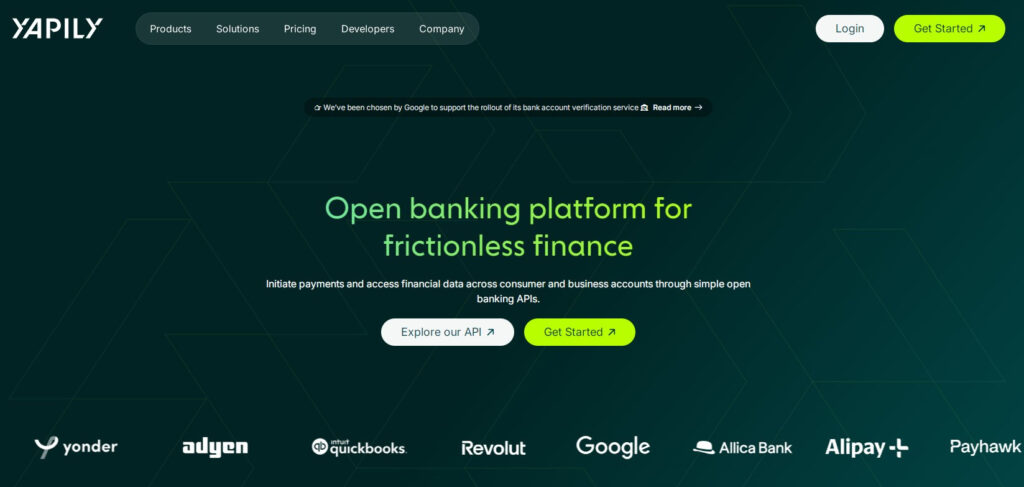
This design choice attracts regulated fintechs and large enterprises that want full control over branding. If you do not want to inherit another vendor’s UX opinions, Yapily fits the brief. The documentation is thorough on regulatory edges.
Coverage spans 19 countries with over 2,000 banks and institutions connected. The UK, Ireland, France, Germany, Spain, Italy, and the Nordics have a strong presence. More than 3,500 applications have been built on Yapily’s API.
Customer results published on Yapily’s website show real impact. Pleo paid £7.3 million into accounts across the UK, Netherlands, and France using open banking through Yapily. Crezco saw a 1,500% uptake in open banking payments since April 2022. Yonder experienced a 132% increase in payment volumes month on month.
The pricing model combines per-call charges with subscription fees. This works well for platforms with predictable volume but can get expensive for high-transaction businesses.
Yapily integrates both AIS for data access and PIS for payment initiation. The platform supports bulk payments, variable recurring payments, and commercial VRP. For platforms that need white-label flexibility and operate across Europe, Yapily deserves serious consideration.
The trade-off comes in development effort. Building your own authentication screens and consent flows takes engineering time. That investment pays off for platforms with specific branding requirements but adds friction for teams wanting a quicker start.
5. Tink
Tink started in Stockholm in 2012. Visa acquired the company in 2022 and turned it into Visa’s strategic open banking platform for Europe. Tink holds AISP and PISP licences across most EU markets and covers thousands of banks throughout the EEA and UK.
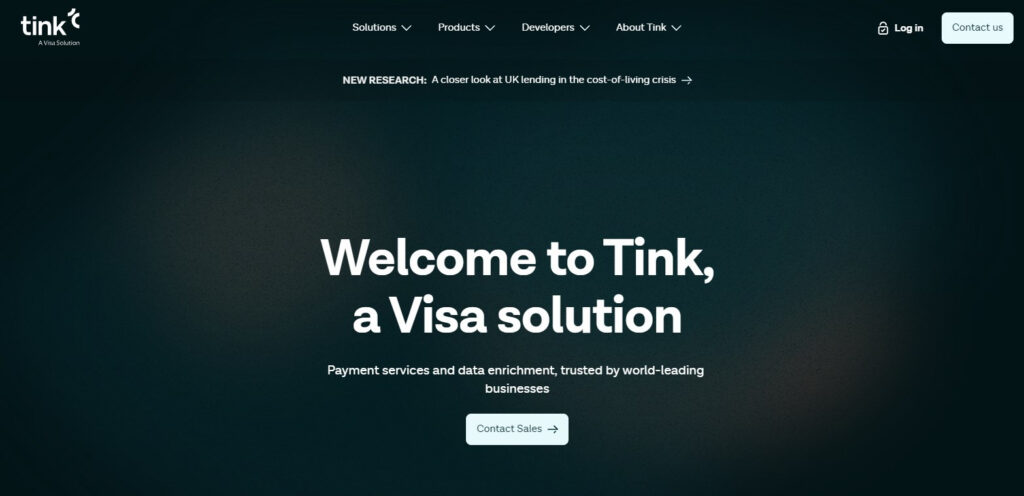
The product set focuses on account aggregation, transaction categorisation, income verification, risk insights, and payment initiation. Tink’s disciplined API design appeals to banks and large fintechs building at scale. The platform processes over ten billion transactions per year.
More than 3,400 banks and financial institutions connect through Tink’s systems. Over 250 million customers across Europe use services powered by Tink. The company operates in 18 sovereignities, including the UK, with offices in ten countries.
Pricing follows an enterprise-first model. For transactions, the standard tier costs €0.50 per user per month with basic services. Enterprise plans get custom pricing plus access to risk insights, business transactions, and income checks. Income verification alone runs €0.25 per check.
The target market matters here. Tink is built for large businesses, financial institutions, and banks. Individual merchants and small businesses are not the focus. Customer support guarantees and response times apply only to enterprise-level clients.
Tink pulled its consumer app from app stores. The company shifted entirely toward providing technology to other institutions rather than being a B2C service. Reviews on the Google Play Store for the old app sit at 4.1 stars, but those come from a different era of the company.
For enterprise platforms with European ambitions, Tink works well. For smaller UK-focused platforms, the procurement process and enterprise pricing create friction.
How UK Platforms Actually Choose a Data Aggregation Provider
The decision usually comes down to three questions.
Where do your users keep their money? UK only or multinational? Finexer provides broad UK bank connectivity and focuses primarily on UK Open Banking workflows. The platform also supports international payout workflows. Plaid and Tink offer broader European coverage but thinner UK-specific depth.
What are you building? Pure data aggregation or payments plus data? Finexer bundles both into one integration. TrueLayer leans heavily into payments. Tink offers both but with enterprise pricing.
Who needs to implement it? Full engineering team or lean development staff? Finexer reports deployment in three to five weeks. Yapily requires building your own UI. Plaid offers the smoothest out-of-the-box experience but opaque pricing.
Quick Comparison Table
Those five providers each take a different path to the same destination. Here is how they line up side by side.
| Provider | UK Bank Coverage | AIS | PIS | Pricing Model | Integration Style |
| Finexer | 99% | Yes | Yes | Usage based, transparent tiers | Unified API, white label |
| Plaid | Expanding, not full | Yes | Limited (UK) | Custom quote, opaque | Link UI, multi-product |
| TrueLayer | Strong | Yes | Yes, high volume | Custom quote | Payments first, hosted pages |
| Yapily | Strong | Yes | Yes | Per call + subscription | Headless, build your own UI |
| Tink | Strong | Yes | Yes | Enterprise, per MAU | API only, B2B focus |
The table gives you a quick scan. Now, let’s see what those rows mean for your platform.
What You Won’t Find on Most Comparison Pages
Open Banking changed UK data aggregation forever. Before 2018, platforms had to negotiate individual integrations with each bank. Different systems. Different security requirements. Different data formats. Open Banking standardised API access across UK banks.
But standardisation does not mean simplicity.
The five providers above all connect to banks through Open Banking. They all return transaction data. They all offer some form of payment initiation. The difference comes down to how they package those capabilities for your specific use case.
Some platforms need accounting workflows with structured data and merchant codes. Others need EPOS integration with real-time payment confirmation. Some need verification for source of funds checks in legal practices. The right aggregator fits your workflow, not just your feature list.
Frequently Asked Questions
People ask the same seven questions every time this topic comes up. Here are the answers based on verified customer experiences.
Which provider offers the fastest integration timeline?
Finexer is designed to support implementation in 2–8 weeks, depending on use case, integration scope, and platform readiness. Plaid offers a quick start through Link, while Yapily may require more development work because teams build more of the user interface themselves.
Do any of these providers offer transparent pricing without contacting sales?
Finexer publishes Startup, Standard, and Enterprise pricing on their website. The sandbox environment is free. No setup or cancellation fees apply. Plaid, TrueLayer, and Tink all require filling out forms for custom quotes.
What about white-label branding on consent screens?
Finexer provides full HTML and CSS customisation for white-label consent journeys. Yapily built their entire platform around headless white-label capability. TrueLayer offers white-label options at enterprise tiers. Plaid Link maintains Plaid branding unless you negotiate custom terms.
Which provider has the strongest customer reviews from verified UK users?
Finexer holds a 4.67 out of 5 rating on Product Hunt. OMR Reviews shows positive feedback from legal, accounting, and real estate professionals. TrueLayer holds a 4.2 on Trustpilot and 4.5 on G2.
Can these providers handle business bank accounts or just personal accounts?
Finexer supports business bank accounts as part of their 99% UK coverage. Plaid supports business accounts through its core linking product. TrueLayer verification focuses on personal account name matching, but business accounts work through their AIS.
What is the difference between AIS and PIS, and why does it matter?
AIS provides read-only access to bank transaction data and account balances. PIS initiates account-to-account payments directly from a user’s bank account. Platforms needing both benefit from providers that offer unified integration rather than separate implementations.
Final Thoughts
Most platforms overthink this decision. They build feature comparison tables with fifty rows and still pick the wrong provider.
Here is what actually separates the good choices from the bad ones. Does the provider understand your specific use case? Do they have verified customers doing what you are trying to do? Can you talk to a human being before signing a contract?
Finexer checks those boxes for UK platforms. Real customers in accounting, legal, payroll, and property tech. Transparent pricing you can see before booking a demo. Deployment in weeks, not months.
The other four firms on this list serve different markets or different company sizes. That does not make them bad. It makes them less relevant for a UK scaling platform that needs both data aggregation and payment initiation from one API.
Pick the provider that has already solved your problem for someone else. Everything else is just marketing.



Leave a Reply
You must be logged in to post a comment.