
Scaling from startup to enterprise is thrilling, yet it comes with fresh hurdles. As cloud environments grow more complicated and compliance rules get stricter, yesterday’s security solutions often show their limits. This is exactly why many teams begin exploring alternatives to Snyk.
They often face issues like incomplete coverage, climbing costs, stricter oversight needs, and a push for deeper insight into their applications, infrastructure, and supply chain.
Snyk is still popular for its developer-friendly approach, and rightly so. But competitors have stepped up with different strengths—ranging from complete DevSecOps suites and runtime-focused prioritization to robust open-source scanning, cloud-native tools, or heavy compliance capabilities.
Here, we outline what really matters when evaluating options and compare the top Snyk alternatives in 2026.
What Enterprises Should Look for in a Snyk Alternative
Snyk dominates developer security, but growing enterprises often find gaps in coverage, pricing, and maturity. An alternative needs an enterprise-grade foundation. Benchmark these five critical criteria.
1. True Enterprise-Grade Policy as Code (Not Just “Rules”)
Snyk’s policy engine works well for small teams, but enterprises require granular, hierarchical governance.
Look for:
- Nested policy inheritance (global, org, repo-level) without brittle overrides.
- Customizable severity scoring that factors in your runtime context, not just CVSS.
- Audit-ready compliance mappings (SOC2, FedRAMP, ISO 27001) with policy change logs.
- Pre-deployment gating that blocks builds based on business logic (e.g., “fail only if fix available AND exploit exists”).
2. Consolidated Platform vs. Point Solution Fragmentation
Snyk acquired its way into SAST, IaC, and container scanning—but integrations remain loose. An alternative should offer a unified data model where a finding in your Dockerfile, your Terraform, and your Java library is correlated, not siloed.
Ask: Does the platform correlate secrets, SCA, SAST, and container risks into a single prioritized backlog?
3. Private Infrastructure & Air-Gapped Deployments
Many enterprises cannot send code to Snyk’s cloud (even via a broker). Critical requirements include:
- Fully offline/air-gapped deployment (on-prem or VPC).
- Local license server for disconnected environments.
- Self-hosted vulnerability database sync (with fine-tuned update windows).
- No required egress to third-party clouds for core scanning.
4. Predictable, Usage-Based Pricing (No Seat Penalties)
Snyk’s per-seat, per-test, per-module licensing often leads to “bill shock” as teams shift left. Look for:
- Unlimited developers with pricing based on manifests, commits, or containers scanned.
- No separate SKUs for container, IaC, or code secrets (one inclusive engine).
- Transparent overage policies—either hard caps or clear elasticity rates.
- Multi-year price protection as your scanning frequency grows 10x.
5. Enterprise Integrations & API Maturity
Many Snyk alternatives perform well with GitHub and GitLab, but they often fall short in traditional enterprise environments.
A few capabilities tend to separate the strong options from the rest. Look for native support for Bitbucket Server, Azure DevOps Server (on-prem), and Gerrit. You’ll also want solid webhook and GraphQL API integration that can handle heavy CI pipeline loads — think 500 or more scans per minute.
Equally important is smooth bi-directional syncing with ticketing systems like Jira Service Management and ServiceNow, including automated remediation flows. Finally, check that the IDE plugins work reliably in offline mode and behind corporate proxies.
6. SLA-Backed Remediation Intelligence
Snyk’s fix advice is strong, but enterprises need operational SLAs. Demand:
- Average time to remediate (MTTR) benchmarks per CVE category from the vendor’s own user base.
- Automated pull requests with verified, tested upgrades (not just version suggestions).
- Backporting support for LTS dependencies when a major upgrade is impossible.
- Vendor-supplied workarounds where no patch exists (e.g., configuration changes).
7. Legal & Compliance Readiness
Your alternative also needs to satisfy procurement and legal teams.
This includes clear data residency guarantees for the EU, US, and APAC with pre-approved subprocessor lists. You’ll want right-to-audit clauses covering both the scanner and vulnerability database.
It should export SBOMs in CycloneDX or SPDX format with full dependency trees, including transitives. Finally, get firm attestations that the vendor’s researchers cannot access your proprietary code.
Best Snyk Alternatives
Snyk pioneered dev-first security, but enterprises outgrow its pricing and maturity. Top Snyk alternatives offer: unified scanning, air-gapped deployment, predictable pricing, hierarchical policy, and SLA-backed remediation.
In the sections ahead, we compare six of the top platforms available right now.
1. Aikido Security
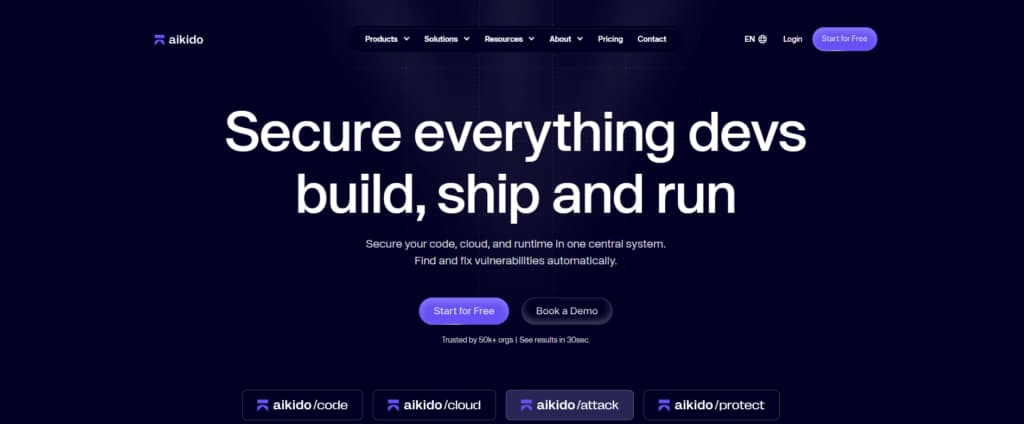
Aikido Security is widely regarded as one of the best Snyk alternatives, securing code, cloud infrastructure, and runtime environments through a single unified platform.
It offers all of the core capabilities offered by Snyk, as well as the addition of cloud security posture management (CSPM), an in-app firewall, open-source license PR gating, and an on-premise scanner, as well as secrets detection (in and out of the IDE).
Additional features that are enterprise-tier only for Snyk are included with Aikido from the outset.
Pros
- 85% fewer false positives than Snyk
- Cleaner, more intuitive UI for developers
- 11 products in one suite vs. Snyk’s 4 core products
- Transparent pricing with no surprise add-on costs
- Includes CI/CD, recursive scans, and enterprise features by default
Cons
- Developer-focused workflows may differ from traditional security platforms
- Teams migrating from legacy security ecosystems may require some onboarding
- Less suited for organizations that prefer highly customized procurement processes
Choose Aikido if your team is tired of Snyk’s noise, hidden costs, and fragmented interface.
Unlike Snyk, which charges extra for enterprise features and leaves you to triage thousands of irrelevant alerts, Aikido combines SAST, DAST, SCA, IaC, CSPM, secrets, and container scanning into one logical workflow with reachability analysis built in. It’s built for developers who want to fix actual risks, not drown in false positives.
2. BurpSuite
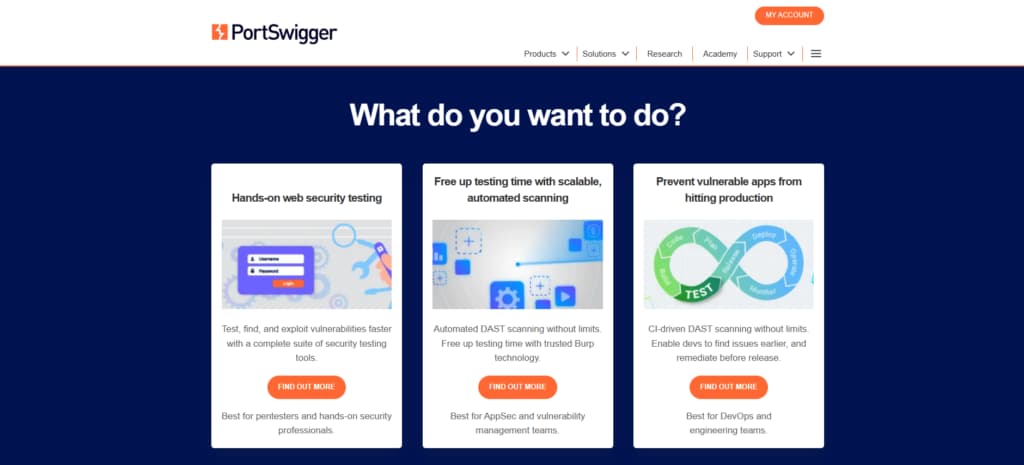
Burp Suite is a professional web application security testing platform developed by PortSwigger and widely regarded as the industry standard for penetration testing.
The platform combines automated vulnerability scanning with advanced manual testing capabilities, allowing security teams to identify, validate, and investigate security weaknesses across web applications, APIs, and modern web environments.
Pros
- Industry standard for deep runtime penetration testing
- Exceptionally low false positives with manual validation
- Extensive extension ecosystem (BApp Store)
- Powerful traffic interception and manipulation tools
- Enterprise edition supports CI/CD and large-scale scanning
Cons
- No dependency or container image scanning
- No Software Composition Analysis (SCA)
- Steep learning curve for manual testing features
- Primarily penetration tester focused, not developer-first
- Limited automated remediation or PR-based workflows
Burp Suite works well if deep runtime security testing is your priority over code and dependency scanning.
Snyk excels at SAST, SCA, containers, and developer workflows. Burp Suite focuses on DAST and penetration testing instead. It helps teams find issues in live applications, test authentication, analyze business logic, and simulate real attacks.
Mature AppSec programs often use it to catch runtime vulnerabilities that code-focused tools like Snyk can miss.
3. Oligo Security

Oligo Security is a runtime-focused application security platform that helps organizations identify which vulnerabilities actually pose a risk in production environments.
Rather than relying solely on static analysis and dependency scanning, Oligo analyzes application behavior at runtime to determine whether vulnerable components, libraries, and functions are actively executed.
This approach helps security teams reduce alert fatigue, prioritize genuine threats, and focus remediation efforts where they matter most.
Pros
- Runtime exploitability analysis (knows what’s actually executed)
- Dramatically reduces vulnerability backlogs by filtering theoretical risks
- Continuous SBOM and VEX reporting
- Real-time impact assessment for newly disclosed CVEs
- Lightweight sensor with minimal production overhead
Cons
- No automated code repair or patch generation
- Not a complete CSPM (no cloud misconfiguration scanning)
- Limited post-incident forensic workflows
- Engineering teams still write and push fixes manually
- Narrower scope than Snyk (no SAST, DAST, or container image scanning)
Your security team needs less noise, not more tools. Oligo Security offers a practical Snyk alternative by focusing on runtime behavior, not just static analysis. It checks if vulnerable components are actually live in production. Result: real, exploitable risks get prioritized. Less backlog. Less waste. More focus on threats that matter.
4. Opengrep
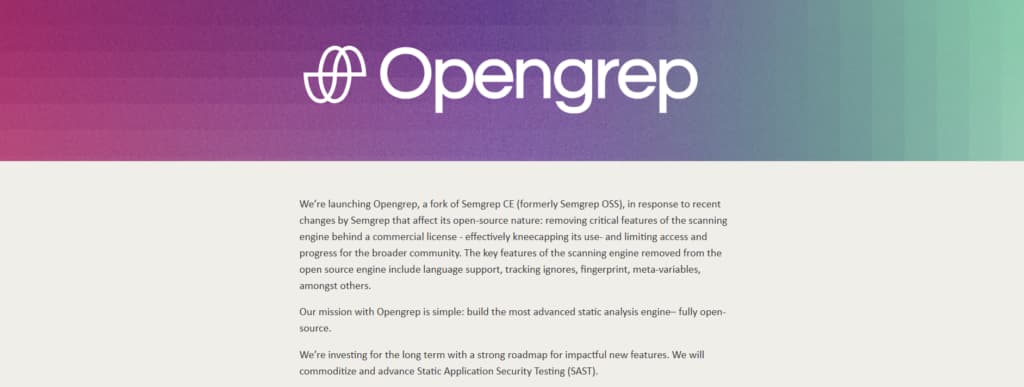
Opengrep started as a community-driven fork of Semgrep following licensing updates in late 2024. Supported by multiple security companies, it maintains an open and transparent approach while remaining compatible with existing Semgrep Community workflows.
The tool uses flexible rules to find vulnerabilities, enforce better coding standards, and identify risky patterns in a wide range of languages. Being fully open source gives teams the ability to review detection logic and build custom rules as needed.
Pros
- Fully open source with transparent, editable detection logic
- Community-driven fork preserving free access to advanced SAST features
- Custom YAML-based rules for organization-specific policies
- No cloud dependency (runs locally or in your own CI/CD)
- Supports inter-procedural and cross-file analysis
- Compatible with existing Semgrep Community Edition workflows
Cons
- No built-in SCA, DAST, container scanning, or secrets detection
- Community support model (no guaranteed SLAs or enterprise support)
- Requires manual rule writing for custom policies
- Smaller ecosystem than commercial SAST tools
- No supply chain or license compliance features
Choose Opengrep if open-source transparency and flexibility are important to your team.
It differs from Snyk by offering a lightweight, inspectable static analysis platform. Organizations can examine the detection rules, add custom ones, and maintain complete control over their processes. Plus, it makes powerful capabilities like inter-procedural and cross-file analysis accessible to everyone.
Opengrep doesn’t try to be a full application security platform—no DAST, container security, or supply chain features. But for teams wanting a customizable open-source SAST tool without vendor lock-in, it’s a compelling choice.
5. Prisma

Prisma Cloud by Palo Alto Networks brings together multiple cloud security capabilities as a single CNAPP. You get cloud posture management, workload protection, runtime defense, compliance monitoring, and vulnerability handling all in one tool.
It’s built for companies using AWS, Azure, and Google Cloud. Teams benefit from clearer visibility, easier misconfiguration detection, workload oversight, and policy enforcement throughout the development process. It’s especially handy if you’re after an all-in-one cloud security approach.
Pros
- Comprehensive CNAPP covering CSPM, workload, and runtime security
- Multi-cloud support for AWS, Azure, and GCP
- Strong compliance monitoring and reporting
- Container and Kubernetes security built in
- Automated forensics and threat investigation
- Dynamic workload identity management
Cons
- Pricing can become expensive for smaller teams
- Steeper learning curve than developer-focused alternatives
- Interface and reporting workflows could be more intuitive
- Overkill for organizations needing only AppSec testing
- Requires dedicated cloud security personnel for full utilization
Choose Prisma Cloud when cloud infrastructure security matters most to you, not just code and dependencies.
While Snyk excels at developer-centric scanning and open-source issues, Prisma Cloud delivers wider visibility into cloud environments, workloads, containers, and live runtime behavior. It spots misconfigurations, supports continuous monitoring, enforces compliance, and protects production apps.
In multi-cloud environments, it provides stronger, unified cloud-native coverage.
6. Tenable
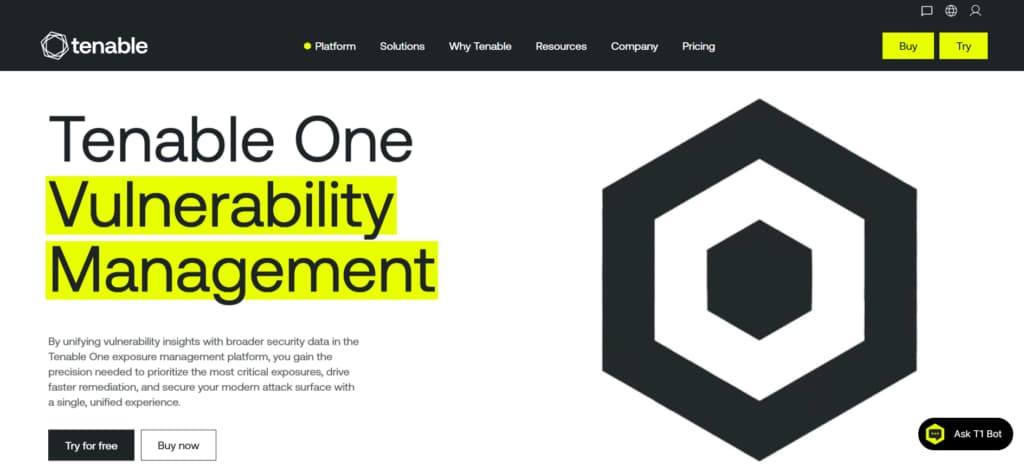
Tenable.io is a cloud-based vulnerability management platform designed to help organizations identify, prioritize, and remediate security weaknesses across networks, systems, cloud environments, and connected assets.
The platform provides both real-time and historical vulnerability visibility, enabling security teams to continuously monitor their attack surface and respond to emerging threats more effectively.
Pros
- Enterprise-wide vulnerability management across networks and cloud
- Continuous asset discovery and real-time vulnerability tracking
- Internal and external scanning capabilities
- Customizable dashboards and role-based access controls
- Regularly updated vulnerability database
- Supports both cloud and on-premises deployments
Cons
- Advanced reporting and compliance customization can be limited
- Extensive feature set requires time to learn and configure
- Less focused on application security than Snyk
- No native SAST, SCA, or container image scanning
- Developer workflow integration is not a primary strength
Go with Tenable.io if comprehensive visibility across infrastructure, cloud, and network is your priority. It differs from Snyk’s developer-focused, open-source approach by specializing in enterprise-level vulnerability scanning and continuous risk tracking.
With strong scanning, flexible deployment, and customizable views, it supports effective risk prioritization in bigger environments. It’s a good fit for mid-sized and enterprise teams seeking centralized infrastructure protection.
Conclusion
Choosing the right Snyk alternative depends on your unique challenges. After all, no platform can solve everything.
Focus on what matters most to your team — their experience level, your cloud architecture, compliance demands, and comfort with pricing surprises. Take the seven criteria above, match them to your requirements, and always run a proper proof of value first.
Thankfully, security tools have improved. No more noise, surprise costs, or disjointed workflows.